How Much Water Is in a Swimming Pool?
Measure length, width and average depth to calculate swimming pool water volume in litres, gallons and cubic metres.
How Much Water Is in a Swimming Pool?
The volume of a swimming pool equals its surface area multiplied by its average depth. For a rectangular pool, that is length x width x average depth. Measured in metres, the answer comes out in cubic metres, and multiplying by 1,000 converts it straight to litres.
Most residential pools hold between 30,000 and 75,000 litres. The exact figure depends on four measurements: length, width, average depth, and shape. Get those four right and you can calculate how much water in a swimming pool of any size sits waiting to be treated, heated, or topped up.
How to Calculate Pool Water Volume
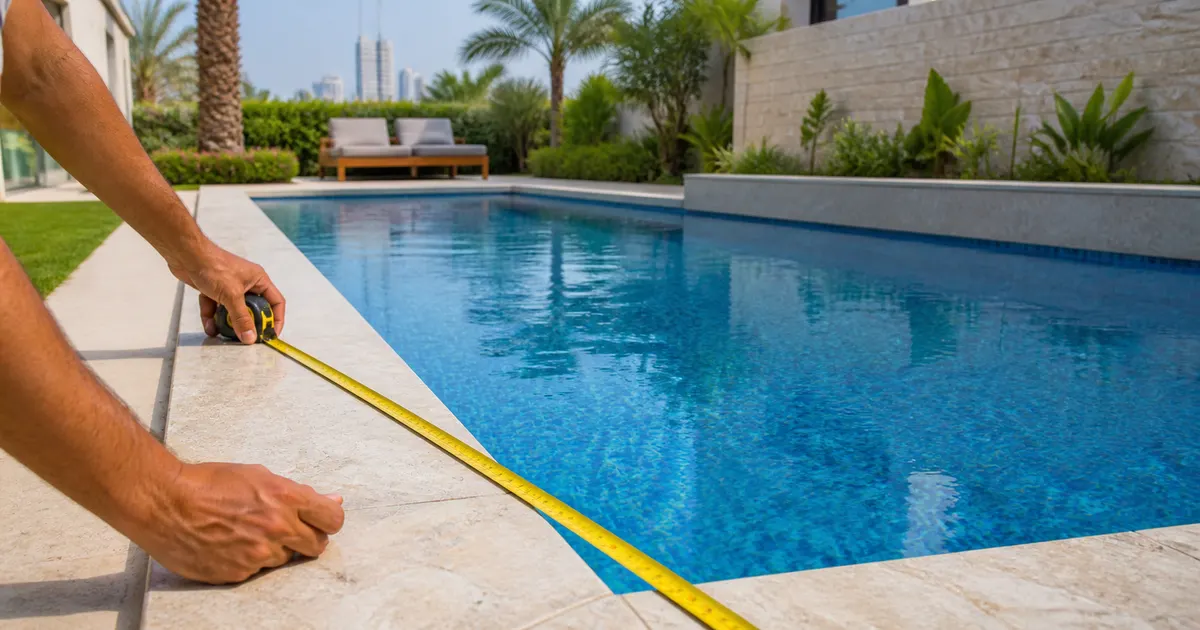
Calculating pool water volume takes three measurements and one multiplication. Measure the length, width, and average depth in metres, multiply them together for cubic metres, then multiply by 1,000 to get litres. The whole process takes a couple of minutes with a tape measure.
Follow these steps for a rectangular pool:
- Measure the length in metres, wall to wall.
- Measure the width in metres.
- Find the average depth by adding the shallow-end and deep-end depths and dividing by two.
- Multiply length x width x average depth for the volume in cubic metres.
- Multiply by 1,000 to convert cubic metres to litres.
Average depth is the step people get wrong. A pool that is 1.2m at the shallow end and 2m at the deep end has an average depth of 1.6m, not 2m. Using the deep-end figure alone overstates your pool water volume badly and throws off every chemical dose that follows.
Pool Volume Formulas by Shape
The pool volume formula changes with the pool's shape, because area is calculated differently for rectangles, circles, and curves. The average depth part stays the same. Match your pool to the closest shape below, then multiply the area by average depth and by 1,000 for litres.
| Pool shape | Volume formula (metres) | Worked example |
|---|---|---|
| Rectangular | L x W x avg depth x 1,000 | 8 x 4 x 1.5 = 48,000 L |
| Circular | radius x radius x 3.14 x avg depth x 1,000 | 2.5 x 2.5 x 3.14 x 1.5 = 29,400 L |
| Oval | long radius x short radius x 3.14 x avg depth x 1,000 | 3.5 x 2 x 3.14 x 1.5 = 33,000 L |
| Kidney / freeform | longest L x widest W x avg depth x 0.85 x 1,000 | 7 x 4 x 1.5 x 0.85 = 35,700 L |
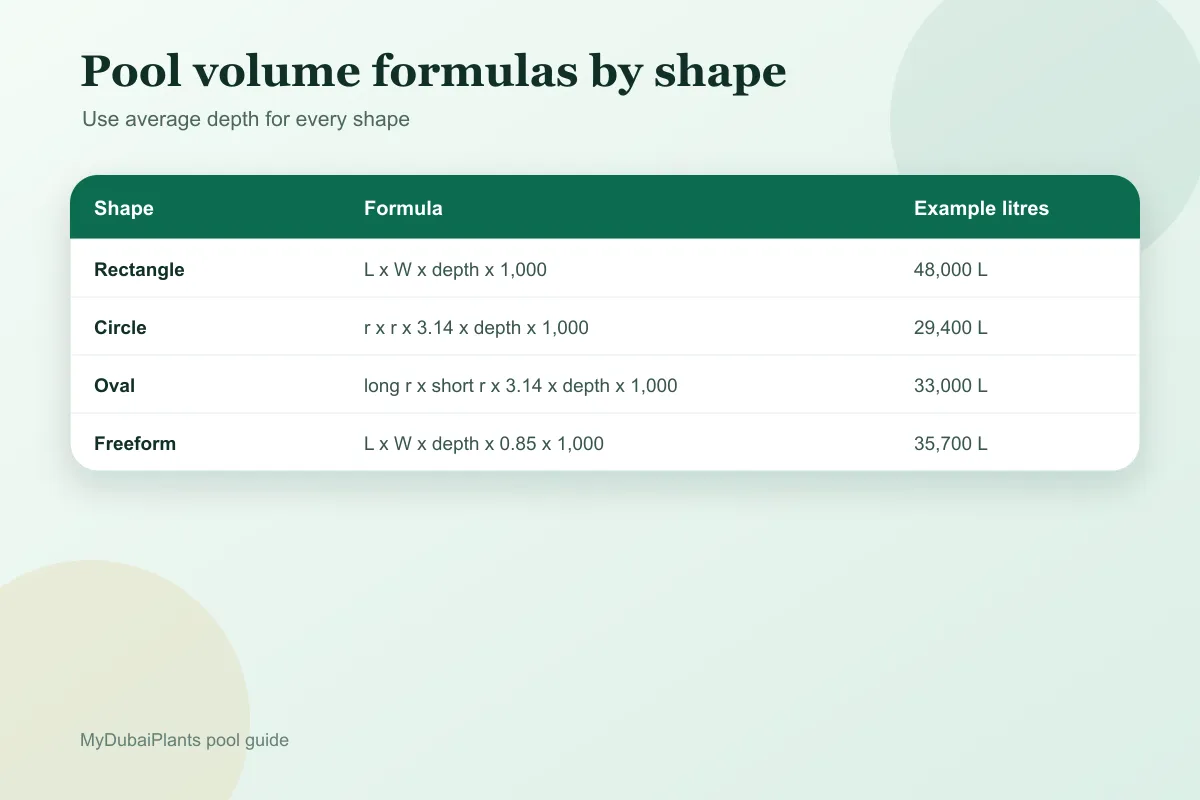
For freeform pools, the 0.85 factor accounts for the curved edges that a plain length-by-width figure would overcount. For a full breakdown of capacity by common pool size, see our guide on litres of water in a swimming pool.
Litres, Gallons, and Cubic Metres: Converting Your Pool Volume
Pool equipment and chemical labels use different units, so you often need to convert your figure. One cubic metre equals 1,000 litres, about 264 US gallons, or roughly 220 imperial gallons. Once you have the swimming pool water volume in one unit, the rest are quick conversions.
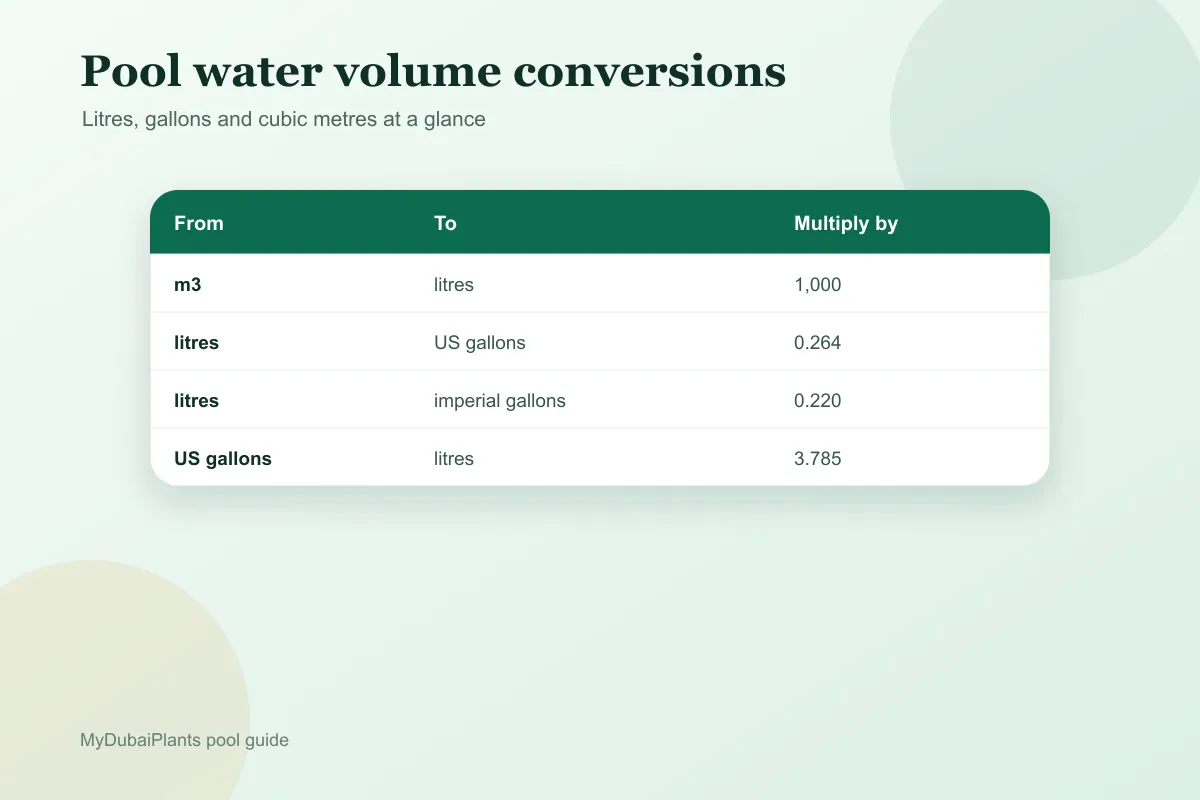
The conversions you will use most:
- Cubic metres to litres: multiply by 1,000.
- Litres to US gallons: multiply by 0.264.
- Litres to imperial gallons: multiply by 0.220.
- US gallons to litres: multiply by 3.785.
For the 48,000-litre example pool, that is 48 cubic metres, about 12,680 pool gallons in US measure, or 10,560 imperial gallons. UAE suppliers and DEWA work in litres and cubic metres, so litres is the practical unit to keep on hand.
Why an Accurate Pool Volume Matters
Knowing how much water is in a swimming pool is the foundation for running it well. Chemical dosing, chiller and pump sizing, and the DEWA cost of the first fill are all calculated against the litre total. An error here compounds into cloudy water, wasted chemicals, or an undersized chiller that never keeps up with summer heat.
It also helps you spot leaks. Once you know your true volume and normal evaporation rate, water loss beyond the expected range points to a problem in the shell or plumbing. Accurate figures turn pool care from guesswork into a routine. The water is only half the picture, though. A pool set into thoughtful poolside landscaping becomes the heart of an outdoor space rather than a standalone tank. Building from scratch? Our custom pool design and construction team handles sizing, equipment, and planting together, and you can start with a free quote.
Frequently Asked Questions
How much water is in a swimming pool that is 8m x 4m?
An 8m x 4m pool at 1.5m average depth holds 48,000 litres, about 12,680 US gallons. Multiply length by width by average depth, then by 1,000 to get the litre figure.
How do I calculate the volume of a round pool?
Multiply the radius by itself, then by 3.14, then by the average depth and by 1,000. A pool 5m across has a 2.5m radius, giving roughly 29,400 litres.
What is the average depth and why does it matter?
Average depth is the shallow and deep measurements added and divided by two. It matters because using the deep end alone overstates your pool water volume and ruins dosing accuracy.
How many gallons are in a typical swimming pool?
A typical 48,000-litre family pool holds about 12,680 US gallons or 10,560 imperial gallons. Convert litres to US gallons by multiplying by 0.264, or to imperial gallons by 0.220.
Do I include steps and benches in the calculation?
For everyday dosing you can ignore them, since they displace only a few hundred litres. For precise treatment on a large pool, subtract a small allowance for steps, benches, and ledges.